When you see an older woman who has developed marked curvature of her spine that resembles a hump in her upper back, you can be certain that lady has multiple compression fractures of her thoracic spine. Thin, short-statured, sedentary, menopausal women have a high likelihood of having osteoporosis. Osteoporosis is a demineralization of the bones (loss of calcium) that leaves the bones soft and easily fractured (broken). The 12 thoracic vertebrae of the upper and middle back are the bones most often affected by osteoporosis.
Menopause and the loss of estrogen therefrom are the factors that cause osteoporosis. When the bones get demineralized they weaken and are very susceptible damage from the slightest provocation. Rolling over in bed, coughing, sneezing, falling, sitting down hard, or metastatic lung, breast, prostate, or thyroid cancer can all cause compression fractures.
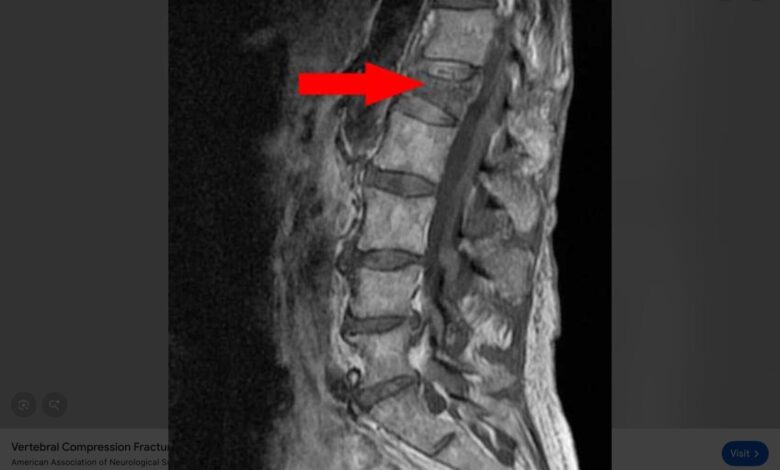
One way to describe a compression fracture is think of the vertebra as an inverted paper cup. If something weighty presses down on the cup, the edge, or the entire body of the cup will crush or collapse. Once it crushes, the vertebra remains crushed. This is a compression fracture and the elderly, women more so than men, are prone to them. The vertebra, instead of being a nicely formed rectangle, becomes a smaller, wedge-shaped triangle.
As more vertebrae become compressed, the thoracic spine becomes kyphotic, or prominently curved. A hump, called a Dowager’s hump, develops in the upper back. This shortens a woman’s height and causes persistent back pain. Compression fractures can be asymptomatic, too. But movement such as bending, twisting, straining to have a BM, etc. will usually cause pain.
Diagnosing a compression fracture is very straightforward. Plain x-rays of the spine or MRI scanning will easily show the location and extent of vertebral collapse.
Treatment involves treating the osteoporosis, controlling the pain, and trying to prevent the compression from worsening. Calcium, vitamin D, calcitonin, bisphosphonates (Fosamax, Reclast), and Forteo are options for treating osteoporosis. Pain can be controlled by acetaminophen or NSAID’s. Supportive bracing and exercise physical therapy helps mobility and flexibility. Local injections, nerve blocks, and nerve root injections all may help pain and mobility.
Treatments under the category of surgery aren’t surgery in the sense we usually think of back surgery. There’s no incision. Instead, vertebroplasty and balloon kyphoplasty are done. Vertebroplasty is the injection of bone cement into the body of the vertebrae. The cement solidifies the collapsed bone and restores it to its original height and shape. Pain is greatly lessened. Balloon kyphoplasty involves the inflation of a balloon inside the affected vertebra to create a cavity into which bone cement is injected restoring vertebral height. Both procedures help reduce pain, but kyphoplasty is better for restoring vertebral height and shape. Vertebroplasty has lost favor over kyphoplasty.
The best plan is to prevent compression fractures by preventing falls and aggressively treating osteoporosis. Calcium, vitamin D, Fosamax, Reclast, Forteo, Prolia, et al. are the place to start. Then being cautious not to fall, etc. should put you in good stead.
References: Creech-Organ J, Organ B. Vertebral Compression Fractures Am Fam Phys 2026 January;113(1):51-56.