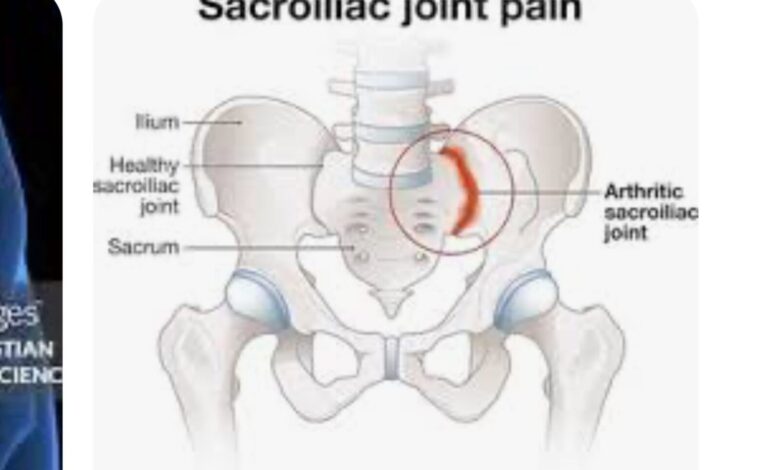
The sacroiliac (SI) joint is not like most other joints. Although it is comprised of two bones, unlike other joints the bones do not move, or they have almost no movement. The sacrum and the ilium are joined together, and although separated by a space, they maintain a fixed position. This type of joint is called a synarthrosis. “Syn” is the Greek root for together or joined, “arth” is the root for joint, and “osis” is the root for condition. A Synarthrosis, then, is a joint whose bones are joined together but without movement.
The sacrum is the lowest bone in the spine. The 5th lumbar vertebra attaches to the top of the sacrum. On each side of the sacrum are attached the right and left ilium, two bones of the pelvis. The right and left sacroiliac joints are the joining of these two bones, thus anchoring the spine to the pelvis. The sacrum and ilium joints are immobile, but they can become inflamed, strained, and even arthritic just like moveable joints.
SI joint pain is relatively common, but often gets better on its own before a doctor sees it. It is caused by trauma, arthritis, pregnancy, and rarely infection. By trauma I mean a fall, a work injury, or auto accident that forcefully strains the ligaments holding the bones together. Pregnancy also strains the joint ligaments, but more gradually on a long term, chronic basis, as the fetus grows to full maturity. Arthritis results from repeated trauma and wear and tear of the joint cartilage. Autoimmune diseases and biomechanical conditions, like a walking boot, can cause SI joint pain, as well. “Anything that puts too much stress on the SI joint can aggravate SI pain, eg. poor posture, standing on one leg, repetitive activities, rolling over in bed and high impact exercise.
Diagnosing SI joint pain is relatively straightforward. The pain is in the buttock and/or lower back, to the right or left of center, and radiates to the groin or thigh. The pain increases after sitting or standing for a long time, by putting more weight on one leg, by climbing stairs, and by running. Sleeping is difficult, especially when lying on the affected side. Long rides in a car can be bothersome.
Sometimes there is tenderness with manual pressure of the SI joint. But if not, there are several “provocation tests” designed to stress the SI joint and reproduce the pain the patient is having. These tests involve forced manipulation of the hip joint in various directions that put strain on the SI ligaments. If three of these tests cause pain, the diagnosis is confirmed. The doctor may also inject local anesthetic into the area of pain to confirm the SI joint as the source of the pain. Reduction or elimination of the pain is confirmatory. Imaging studies can be done, but are not as helpful as the provocation tests.
Treatment of SI pain is usually conservative. As I mentioned before, it can get better on its own, but if not, physical therapy, NSAID’s, stretches, and/or a corticosteroid/local anesthetic injection are first line options. The few times I injected one or both SI joints I was successful. The patient got better. Surgical fusion of the SI joint is an option but is rarely necessary.
Prevention is the best treatment. Proper lifting techniques, good posture, avoidance of prolonged standing and sitting, good nutrition, regular exercise, reduced stress, learning to relax, and maintaining a stable weight are preventive measures.
References: Newman DP, Soto AT. Sacroiliac Joint Dysfunction: Diagnosis and Treatment. Am Fam Phys 2022; 105(3):239-245.
Sacroiliac Joint Pain. Patient Care. Mass General Brigham
Sacroiliitis MayoClin.org.
Orlando M., Lynch S. Sacroiliac Joint Pain. MayfieldClinic.com May 2019.