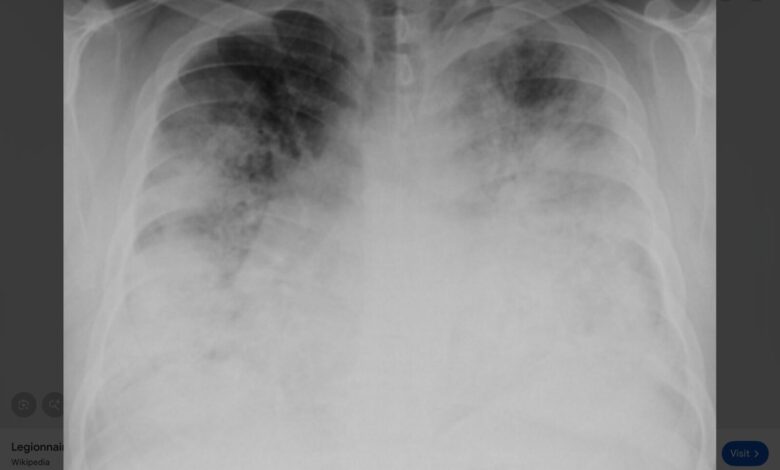
The current issue of American Family Physician, the journal of the American Academy of Family Physicians, has an article titled “Photo Quiz.” This article presented a case of a respiratory infection acquired by a 60-year-old man. He had been ill for 5 days with fever, dry cough, nausea, diarrhea, weakness, and poor oral intake. His temperature had risen to 103°, and he had tested negative for influenza and COVID-19. He was not a healthy man having Type 2 diabetes, gout, and rheumatoid arthritis. Significant in his history was his frequent use of a whirlpool spa in his apartment complex.
Also in the article was a photograph of his chest X-ray which showed findings of pneumonia in the right lower lung. His heart size was slightly larger than normal. He had no free fluid in either side of his chest. Lab-wise he had a low sodium, elevated liver enzymes, and an elevated magnesium. On exam, he had a fever of 102°, pallor, low blood pressure, and appeared ill but was not in respiratory distress.
The reader was then asked to make a diagnosis. Four options were given. They were influenza pneumonia, a viral infection that was ruled out by a negative influenza test. Second was Mycoplasma pneumonia, the organism that causes “walking pneumonia.” People with Mycoplasma are younger, don’t usually have fever of 103°, and are not terribly sick. The third option is Streptococcus pneumoniae. This causes cough, fever, and a chest X-ray that looks much worse than this man’s.
So we’re left with Legionnaire’s disease caused by Legionella pneumophila. The clinical presentation fits, and the patient has co-morbidities that make him susceptible to the bacterium. Pertinent in his history is the frequent use of a public whirlpool spa at his apartment complex, plus Legionnaires’ commonly has GI symptoms and low sodium levels. Legionella pneumophila is an atypical bacterium spread by aerosolization of contaminated water by a device that uses water in some capacity. In 1976, it was the rooftop air conditioning units at the Bellevue-Stratford hotel in Philadelphia. American Legion members were at a convention at the hotel, and many developed a strange respiratory illness that was not caused by a known organism and failed to respond to standard antibiotic treatment. Around 210 legionnaires became ill and 34 died!
Fortunately, experts at the CDC quickly isolated and identified the organism and discovered it was sensitive to macrolide antibiotics (ie. Erythromycin, clarithromycin, Azithromycin) which have become the treatment of choice.
The organism, Legionella pneumophila, is not easily cultured from sputum produced by a patient with Legionnaires’. The diagnostic test of choice is a urine antigen test which is reliable. Our patient in the above scenario was treated with Azithromycin, fluoroquinolone, and a beta lactam antibiotic, which brought about resolution of his symptoms.
Today, with the knowledge gained in 1976, Legionnaire’s’ treatment is not delayed because the clinical history is easily recognizable, the diagnosis is quickly established, and treatment is started immediately, usually with successful outcomes.
Outbreaks of Legionnaires disease still occur, but the mystery of the illness has been solved. Effective antibiotics are employed early and recovery rates are greatly improved. Still, however, death rates of 10% are a concern. But the stigma of this being a fatal disease has been erased by brilliant scientists at the CDC.
References: Ferreio F, Clem T. Focal Infiltrate in a Patient with Extrapulmonary Symptoms Am Am Phys 2026 November; 4(5):537-538.
www.google.com/article/legionnaires-disease-history