AI-ENHANCED STETHOSCOPE IS A DIAGNOSTIC BOON

I can’t imagine what it’s like to be a physician and never use a stethoscope. The stethoscope, after all, has long been the symbol that represents being a medical professional, and there’s a certain air it presents when a person wears one. At the start of medical school, a pharmaceutical manufacturer gave each freshman student an inexpensive, plain Littman stethoscope as a congratulatory gesture for being accepted to medical school. I cherished that instrument, and although we didn’t use a stethoscope until the second semester of our sophomore year, I occasionally got it out and wore it around my neck like I was big stuff!
In my practice, I used my stethoscope on just about every patient. I kept it in my coat pocket, or around my neck, all the time. It was always within reach. There are a lot of doctors, however, who never use a stethoscope. Dermatologists, ophthalmologists, radiologists, psychiatrists, and other less “hands-on” specialists never use a stethoscope. In fact, I would bet most of them don’t have one and if they do, wouldn’t be able to find it.
The stethoscope is a valuable tool every medical student learns to use. There really is an art to using it properly and when you do achieve that level of expertise it’s like having a third ear. Some cardiologists are so good at cardiac auscultation (listening to the heart) they’re able to hear murmurs and sounds no one else can hear. But the playing field has been leveled with the introduction of an artificial-intelligence-powered stethoscope.
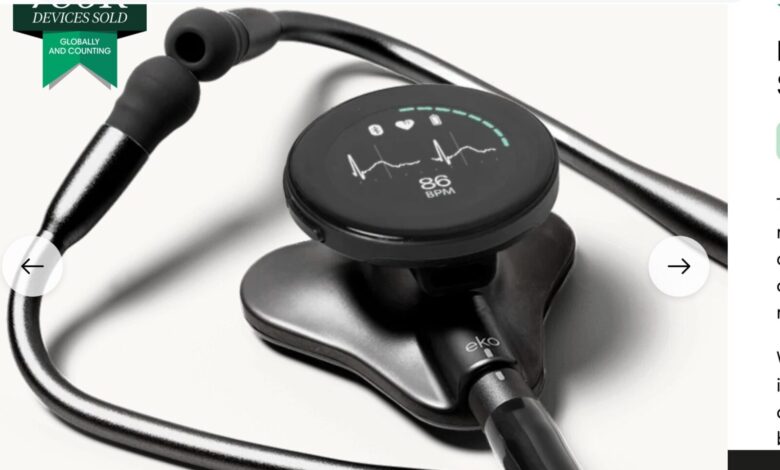
This is a “digital device that combines sound amplification with machine learning to detect heart murmurs, structural heart disease, and arrhythmias in real time.” The AI-stethoscope “doubles the sensitivity for detecting moderate-to-severe heart valve diseases” when compared to a regular stethoscope. In other words, the AI-stethoscope hears the heart much better-actually, 40 times better, with background noise filtered out.
“The most significant advancement lies in the ability of AI-powered stethoscopes to record multiple physiological signals, including heart sounds and ECG rhythm recordings.” That means the AI-stethoscope can more easily diagnose heart failure, atrial fibrillation, and valve problems, earlier and more accurately. It enables an ECG to be produced by recording sound waves. This device does everything that a regular stethoscope is capable of doing, but on a much broader, grander scale with much greater sensitivity.
These advancements mean that primary care doctors will have a diagnostic advantage they heretofore have not had. It’s a tool that will benefit doctors and patients alike when heart patients will be diagnosed earlier, more accurately, and treated more effectively. In its advertisement, one of the devices, the EKO Core 500, claims it’s sound quality is 8 times better than a conventional stethoscope. It also claims 93% sensitivity and 91% specificity for detecting valve problems, is 95% sensitive and 94% specific for detecting atrial fibrillation, and 85% sensitive and 70% specific for detecting heart failure.
This fancy stethoscope is a good example of how AI is not going to replace humans but instead will make life and work easier while enhancing the accuracy of the diagnostic tools we currently use. Embrace it. It’s here to stay.
References: Carpello AI Stethoscopes May Aid Early CVD Detection. medscape.com 2026 August 18.
www.google.com/artificial-intelligence-stethoscopes.