

If you’re my age (82), you undoubtedly remember the first television set your family had. I don’t remember the actual TV set we “owned,” but rather I remember things about it and about what we watched on it. At that time, our family had a natural conduit to the latest in communications technology because my dad was the buyer of major appliances and radio and television for L.S. Ayres and Co., the largest department store in central Indiana. As a result of his position, he was up to date on the latest developments in television and knew which brands and models had the best picture and most efficient reception. And the manufacturers from whom he purchased the TV’s were more than willing to let him try the latest and best models at home. So, we always had a very nice, yet expensive, brand new TV set in our home. They were traded out about every six months. Just when you were getting used to a Zenith, the Ayres delivery guys brought us a brand new Sylvania with a 17” screen! It was a great perk to have access to a huge 17” picture tube after getting used to a tiny 12” screen.
My first real memory of watching television was in May, 1952. Indianapolis had only two TV channels back then; channels 6 and 4. The two first came on the air 6 months apart—channel 6, or WFBM, May 30, 1949, and Channel 4, or WTTV, November 11,1949–and neither was a cable channel. In fact, there was no cable in 1949.
To see the picture on our set, we had to capture the signal sent from the transmission tower somewhere out in the boonies using the infamous “rabbit ears” antenna that sat on the top of the set. Those crazy “rabbit ears” were very temperamental and had to be adjusted all the time to try to get a sharper tv picture. We tried everything we could think of to get a clearer picture. It was a constant battle to get rid of the “snow” on the screen. Antennae came in other shapes than rabbit ears. You might see elaborate geometric designs or aluminum foil wrapped around the ends of the “ears” in the hope of a clearer picture.
As technology improved, so did reception when large antennae were installed outside on the roof of the house. We had several different antennae over the years, all with the intent of getting a better picture than we had previously. One setup we had was attached to a motor that rotated the antennae in the direction of the signal coming from the tower of the channel we wanted to watch. There was a box on top of the TV that rotated the antenna when we changed channels. Needless to say, when the rotator worked our picture was fine, but it had a temperamental streak about it that frustrated even the most patient individual.
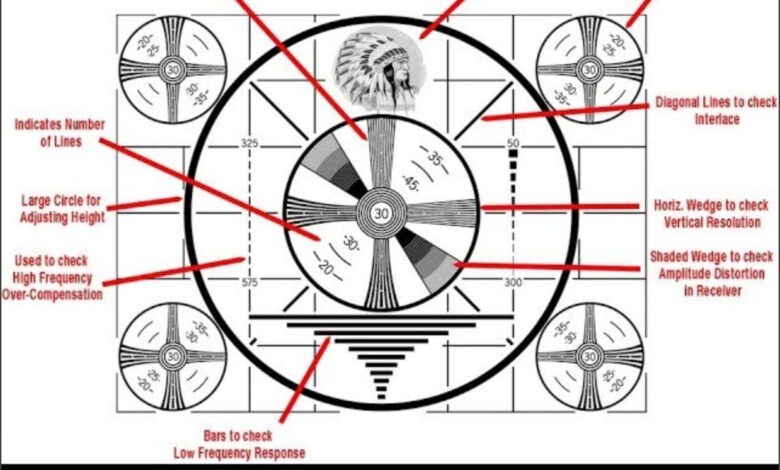
I mentioned May 30, 1952, as my first memory of TV. That was the date of the telecast of the 1952 Indy 500 mile race won by Troy Ruttman. That was the biggest telecast in the previous existence of WFBM TV, channel 6. Before that race, broadcasting was limited to only parts of the day. I particularly remember programming from 6:00 pm to 11:00 pm that began and ended with news and weather forecasts. Before 6:00 pm, when the station was not on the air, there either was no video/picture and the screen was blank, or 30 minutes before it went on the air, the station ran a “test pattern.” A picture of the WFBM test pattern is attached to this article. Each line or image in the “pattern” had a purpose in the clarity of the picture. I remember as a 10-year-old sitting in front of the TV staring at the test pattern, mesmerized by it, and waiting with great anticipation for what was about to come.
Programming was very limited. Big networks were in their infancy so much of what we saw was local programming. The local news at 6:00 pm and 10:00 pm was anchored by Gilbert Forbes while the weather was reported by local dentist, Bill Crawford. He started every broadcast with his signature salutation, “Hi.” Simple, quick, and memorable, his popularity was instant. Sports was the domain of the broadcasting legend, Tom Carnegie, who doubled as the PA announcer for the Indianapolis Motor Speedway —“It’s a new track record!” And there’s “day—bree” on the track. Mid-day were farm reports from the agriculture department quoting prices of barrows and gilts. Harry Martin, the local farm agent, always had a lot to say about the prices of corn, soybeans, wheat, cattle, sheep, and pigs, every day at noon.
Channel 6 became known as “Woof Boom,” a loose pronunciation of the call letters of the station. Eventually, programming came along like Kukla, Fran, and Ollie, the puppet show I watched every day. I loved it when Ollie, the alligator, grabbbed Kukla, the clown’s, nose in his jaws. Howdy Doody with Buffalo Bob and Clarabelle the clown, kept my attention, but not completely. Jack Benny, Milton Berle, Ozzie and Harriett, George Burns and Gracie Allan (I never understood how Gracie could be so dumb), Groucho Marx, and Lucille Ball and Desi Arnaz kept us laughing non-stop year after year.
Television was changing American society. Five or six hours of programming extended into 12 hours, which was soon followed by 24-7 TV programming. New stations with different styles came as did new shows that quickly developed iconic status. More and more sports programming appeared, as did news coverage that kept us up to date minute to minute. Channel 6 kept the farm reports alive for decades more until interest was no longer there. And Harry Martin stayed at that job until the late 1970’s. In 1983, Martin was inducted into the Indiana Broadcasters Hall of Fame.
Kids programming was big, too. Along with the puppet shows was the innovative “Winky Dink” hosted by Jack Barry. An interactive program, the viewer had a clear plastic film he attached to the surface of the TV screen. Barry drew figures and caricatures on a clear glass up against the TV screen. The viewer (me) traced his drawing using a magic-marker-like pen that copied the image on the plastic film. When the tracing was finished, the film was removed from the screen leaving me with a perfect replica of the picture Barry had drawn. That show fascinated me. I had my own “Winky Dink Kit” that I used every Saturday the show was aired.
Wild Bill Hickok’s program had a contest for writing a slogan for their sponsor. I entered that contest, along with many other contests always optimistic I would win, but I never did. My brother entered, too, and was one of the top 25 entries, but only first place won a prize. I never won anything, but I can also proudly say, “Captain Midnight” never influenced me to buy a can of Ovaltine! That product still has never crossed my palate and never will.
WFBM, channel 6, was a big part of my life growing up. It was our television station. Channel 4 , WTTV, came about the same time, but it was based in Bloomington, Indiana, and other than Indiana University basketball games, I don’t remember watching it that often. My first taste of IU basketball came in the early 1950’s when Branch McCracken coached IU, led by Bobby Leonard and Don Schlundt, to its second NCAA championship by beating defending champ, Kansas, by one point. Indiana University was a big part of my life, too.
You probably have special memories of your first TV set, and what you watched, too. Those memories have endured a mere seventy years, and are still fresh in my mind. On television I saw Neil Armstrong put his foot on the moon, I saw Keith Smart make a shot to win the 1981 NCAA championship, I saw the second plane hit the World Trade Center on 9-11, I watched President John F. Kennedy’s funeral, AND I watched IU go undefeated and win a national championship in football, BUT I never bought an ounce of Ovaltine, and will never use Geritol or Carter’s Little Liver pills.
References: www.google.com/ many references to WFBM, Indianapolis television, WTTV, Harry Martin, Gilbert Forbes, Bill Crawford, and Winky Dink.



All your comments brought back so many memories. The selection of shows were so limited that we probably all saw the same show. I remember my dad watching the Saturday night boxing matches. Also the election shows with Eisenhower. You were lucky to be able to have the latest TVs. The Six of us in my family got to watch a small screen.