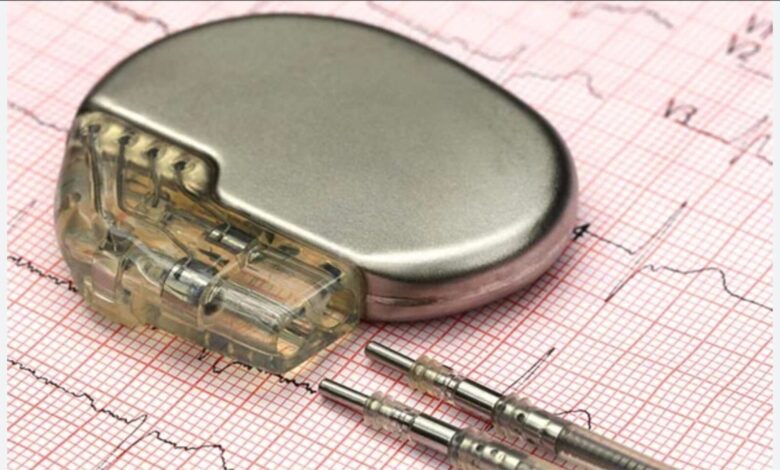
Pacemakers are one type of implantable cardiac device. There are several (see below) such devices, but pacemakers are the type most commonly used. They deliver electric impulses to the heart by stimulating the chamber where the pacemaker wire is located. “Conventional pacemakers” are quite simple and contain a pulse generator and wires that carry impulses from the pulse generator to the heart. The wires also work in reverse to capture the electrical activity of the heart and provide doctors with information on what rhythm problems are causing the patient’s symptoms.
Other implantable devices are Dual-chamber pacemakers, Bi-ventricular pacemakers, and an “implantable cardioverter-defibrillator” (ICD). The battery pack of these devices is surgically placed under the skin usually in the upper right chest just below the collar bone. From the battery pack a wire(s) are fed into large veins connecting to the heart. The wire is fed into the heart and becomes embedded in the heart chamber where pacing occurs.
In a single-chamber pacemaker the lead (wire) is placed in the right ventricle. In a dual-chamber pacemaker, the wires are in the right ventricle and right atrium, and a third wire is in the coronary sinus which paces the left ventricle. An ICD (defibrillator) is implanted under the skin in the pectoral area, and the wires are fed through a vein and go directly into the heart. Pacemakers can also be leadless. They attach to the right ventricle and function like a single-chamber pacemaker.
Pacemakers have two main indications:
1. The heart is beating too slowly OR
2. Electrical impulses are moving through the heart too slowly, and skipped beats are occurring.
Problem one is due to malfunction of the sinus node, the site where all heart beats originate.
Problem two is due to dysfunction of the conduction system where impulses are transmitted too slowly from the upper chambers to the lower chambers. Beats are being skipped or not occurring at all. This is called HEART BLOCK.
HEART BLOCK is sub-categorized into first degree atrioventricular (AV) block, second degree block, and third degree, or complete heart block.
First Degree AV Block—an electrical impulse takes longer than 0.20 seconds to go from the atria to the ventricles.
Second degree AV Block—each consecutive impulse takes longer to go from the atria to the ventricles until it does not complete the transit and a beat is dropped (or skipped).
Third degree AV Block—the electrical connection between atria and ventricles is completely blocked and no impulses get through to the ventricles and no beats occur.
Between the upper and lower chambers is an area of specialized cells called the atrioventricular (AV) node. All impulses pass through this “node” and then disperse over the ventricles to cause a contraction of the heart. Dysfunction in the AV node is another cause for skipped beats. The atrial impulses get blocked by the node and don’t cause ventricular contractions. With no impulses being transmitted, blood flow ceases and the patient becomes unconscious (syncope ie. passes out). If this situation is not corrected emergently, death is imminent.
There are several other situations when specialized pacemakers are indicated, but in the majority of cases either the sinus node is not producing impulses regularly, or the impulses from the sinus node are not making it to the ventricles, and the ventricles are not contracting. A pacemaker produces the electrical stimulus that replaces the absent naturally-produced stimulus.
The above explanation is a highly simplified version of the details. There is a lot more detail to be known about devices as well as many other complex conduction abnormalities that are too complicated and too detailed to cover here. Suffice it to say, the simplified version is that a pacemaker “paces” the heart when the heart is failing to “pace” itself. Without the stimulation from a pacemaker, a patient essentially has no heart beat. And that situation is incompatible with life.
Reference: Lanney H, Hu Y, Karnovsky SC. Pacemaker Therapy: Indications and Recommendations Am Fam Phys 2026 June;113(6):551-558.