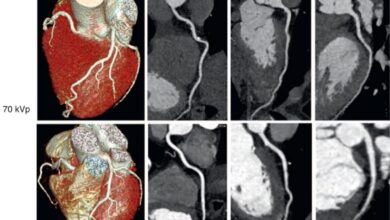
As I recently discussed in the coronary anatomy article, the left coronary artery begins as a large single vessel, the Left Main, and quickly branches into the Left Anterior Descending (LAD) and Left Circumflex (LCx) arteries. Atherosclerotic disease blocking the left main coronary artery can have fatal consequences if it isn’t treated at the first indication of problems. An occluded LM disrupts blood flow to the entire left side of the heart, a situation most patients cannot survive.
Treating Left Main Coronary artery disease has two options; one that involves surgery and one done during a heart catheterization. Those options are Coronary Artery Bypass Grafting (CABG) and percutaneous coronary intervention, better known as angioplasty and stenting.
Coronary Artery Bypass Grafting (CABG) is a major chest operation during which segments of vein harvested from the saphenous vein in the leg are used to bypass the critical blockage in the LMA. The bypass shunts blood past the occlusion and into the artery beyond the blockage to reestablish circulation.
Percutaneous Coronary Intervention (PCI) is also called Angioplasty and stenting. In this heart catheterization procedure, a balloon catheter is placed in the LCA, the blockage located, the balloon catheter is placed within the blockage and the balloon expanded. This opens the blockage. Then a drug-eluting stent is placed in it to keep it from reclosing.
Because of the seriousness of LMCAD, and because both of these treatments are invasive and accompanied by significant risk, numerous studies comparing the outcomes of these treatments have been done to determine which is safer, has a lower mortality rate, and is more effective. A summary of the results of these studies follows:
A European study comparing CABG and PCI found “no significant difference in 10-year all-cause mortality between the two. CABG—23.1%, PCI—23.5%.”
Five-year results from the EXCEL Trial found “no significant differences…in the primary composite endpoints of all cause mortality, heart attack, and stroke. PCI was associated with a higher all-cause mortality.”
In 2021, a meta-analysis of multiple trials “reported no significant difference in 5-year all-cause mortality between PCI and CABG, with mortality rates of 11.2% and 10.2%.
British and American analyses examining outcomes after 5 and 10 years have shown comparable mortality rates between the two treatments. The British study, however, showed that CABG is “often preferred in patients with more extensive Left Main disease.”
Dr. G’s Opinion: In this situation, because I’m not a cardiologist, my opinion comes from a patient perspective. Since study after study has shown no significant difference between the two treatments, I would definitely prefer the PCI procedure. In the hands of the right cardiologist, my chances for a successful outcome are reasonably good.
Reference: Richeux V. Left Main Coronary Artery Disease: Can New 10-year Data Settle the Debate. medscape.com 2026 June 6.