“What question is that?” you ask. The question on the minds of doctors, nurses, friends, and family is what was wrong with Grandma. She was so sick for so long. It’s a terrible shame she had to die before we were able to find out what she had. All kinds of blood tests and imaging studies were done, but we didn’t have the true answer until her autopsy.
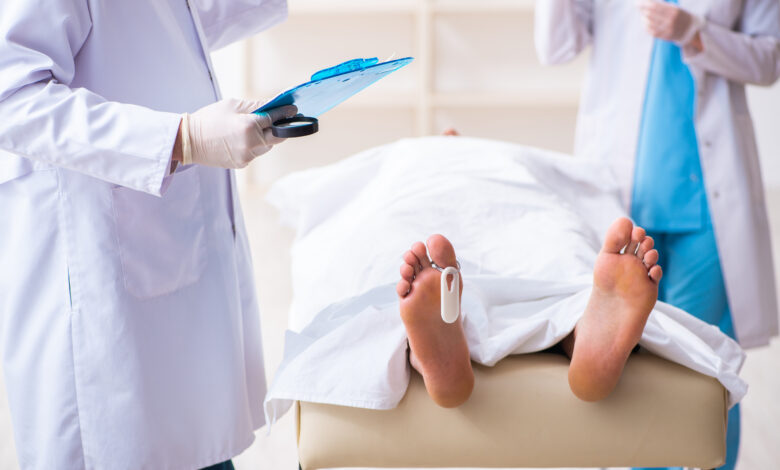
Autopsies aren’t done very often these days. In fact, I can’t really recall an autopsy being done on any of my patients in the forty years I was in practice. They simply aren’t necessary like they were before we had CT, MRI, and the needle biopsy techniques of today. In almost all cases, the patient’s diagnosis had been determined before death, and that determines the treatment prescribed. If there had been any question as to the diagnosis, an autopsy would be requested upon death.
One exception to this situation is in the case of accidental death or death by suspicious means. In this scenario, the attending physician will deem the situation a coroner’s case and order an autopsy be done by the coroner’s office. In these forensic cases, things are done somewhat differently in that toxicology studies and targeted microscopic examinations may be done. An example would be the young man who lives alone and is found dead by his neighbors. He has no known reason to die suddenly like this so his death is declared a “coroner’s case,” and an autopsy is scheduled. Most of the time the cause of death is established answering questions with life insurance implications or criminal consequences.
In medical school, we learned about autopsies in the second year. It was part of our pathology course which seemed to last both semesters. We students were placed on a call list and when an autopsy was to be done, we were notified and required to attend. It was always an interesting experience, but not something I would choose to do the rest of my career.
In spite of the fact autopsies are done rarely these days, there are still strong advocates for the procedure who point out its advantages and the values. A recent Medscape article lists “11 Reasons [why] an Autopsy is Valuable.” I thought the values might be of interest to you just as they were to me.
- An autopsy compares pre-death and post-death findings. Eg. Did the patient have liver metastases as shown on the CT scan?
- It helps produce accurate vital statistics. Eg. These autopsy findings add data for a specific disease.
- It establishes a clear cause of death.
- It evaluates the effectiveness of therapies. Eg. Did radiation therapy affect bone mets?
- It’s a learning tool for medical students, residents, attending physicians.
- It assists in determining the manner of death.
- It protects against false liability claims and settles valid claims quickly and fairly. Eg. Was there evidence this condition was pre-existing?
- Helps to monitor public health. Eg. Any evidence of communicable disease of public health consequences.
- Identifies new and changing diseases. Eg. What might have caused this person’s unusual symptom.
- Assesses the quality of medical care.
11. Reassures family members regarding familial diseases and hereditary syndromes. Eg.
Grandpa had no sign of Huntington’s disease.
This is a bit of an academic exercise, but one has an idea, now, of the reasons for, and value of, autopsies. As mentioned, technological advances have made autopsies as rare as an IU Men’s basketball win, but they still serve a purpose. Knowing about them is valuable knowledge should an unexpected, unwitnessed, unexplained death occur.
Reference: Lundburg GD. Where Death Delights: Resurrecting the Autopsy. Medscape 2026 February 6.