Warfarin (Coumadin) is the most widely prescribed oral anticoagulant in North America. Worldwide it has been the standard of care for decades. Its dominance has been challenged in recent years by the new class of blood thinners called “direct oral anticoagulants.” These drugs are commercially known as Pradaxa, Xarelto, Eliquis, and Savaysa. The advantages of these new drugs are that ”one dose fits all,” and management of them does not require blood testing. When you take Pradaxa, for example, everyone takes the same dose, and the level of anticoagulation is not measured by a blood test. They are also alleged to have fewer side effects, but I take exception to that claim. The disadvantage is they are significantly more expensive than warfarin. Warfarin has been in use since 1954.
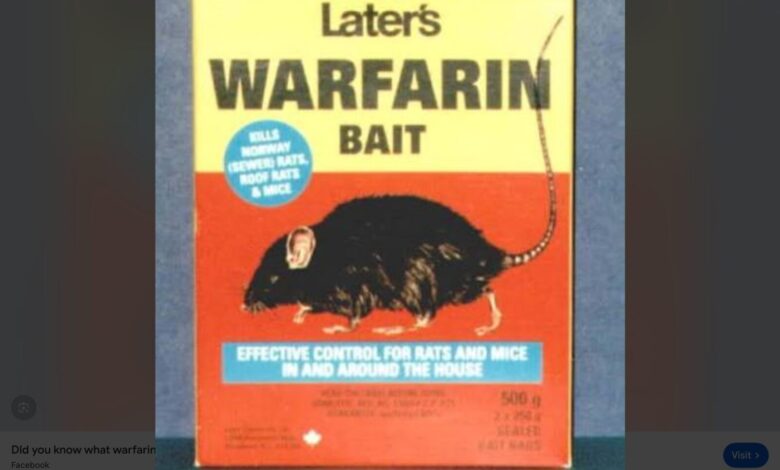
Warfarin, known commercially as Coumadin, is often erroneously equated with rat poison. In today’s pharmacology world that claim has some validity, but only historically. Warfarin is the end result of 34 years of discovery, refinement, elimination, and re-refinement by scientists who were able to separate the anticoagulant properties from the “rodenticidal” actions. The end result was a blood thinner that prevented stroke in atrial fibrillation and patients with heart valve disease, and treated deep vein blood clots and pulmonary emboli (blood clots in the lungs) while not being harmful to humans.
The story of warfarin is one of patience and genius. In the 1920’s a mysterious disorder was causing Canadian and North American cattle to internally bleed to death. They were experiencing a hemorrhagic condition called “sweet clover disease” caused by grazing on damp hay that became infected with mold. The problem was serious enough that a Wisconsin farmer took a “milk can of unclotted blood” to a biochemist for analysis. Six years of evaluation, finally resulted in the isolation of the blood thinning compound (it has a 9-syllable chemical name) that they named dicumarol. In the 1940’s, scientists began synthesizing dicumarol while more uses were being discovered. This research was funded by the Wisconsin Alumni Research Foundation (WARF).
Further study developed 150 variations of dicumarol one of which was a potent rodent killer, but did not adversely affect larger animals (eg. dogs, cats, children). Others were found to be effective blood thinners so from one compound, dicumarol, a rodent poison and therapeutic anticoagulant were developed. Coumadin/warfarin became that anticoagulant and was approved for human use in 1954.
This research and development of warfarin was all done at the University of Wisconsin and funded by the Wisconsin Alumni Research Foundation or WARF. When the compound reached its final stage of development, it was given the name WARFarin, to give acclaim to the organization which had promoted the R & D. It’s interesting that the compound found to be the most effective at killing rats was the same one proven to be safest and most effective for preventing blood clots in people. Warfarin sodium could be given orally, was managed through regularly scheduled blood tests, and was reversible by vitamin K, aquamephyton.
The historical accounts I found on warfarin contained a lot more detail including the names of all individuals who played a significant role in warfarin development, and those of celebrity status who were therapeutic successes early on. One of the most famous was US President Dwight D. Eisenhower who was prescribed warfarin after a heart attack in 1955. Also alleged was that Nikita Khrushchev and his acolytes conspired to kill Josef Stalin using warfarin.
It is paradoxical that a drug fatal to rodents is harmless to humans. Harmless, that is, as long as the therapeutic dose, as determined by Prothrombin time and INR blood testing, is not exceeded. Excessive doses of warfarin causing the INR to be over 3.0 (normal range is 0.8 to 1.2) can potentially cause severe internal bleeding.
So, if anyone alleges that warfarin is a dangerous drug because it is also rat poison, tell them to check their facts. The “cidal” effects of warfarin are harmless to humans, but the anticoagulant effects could be life-saving—or at least stroke-saving. This paradox has been tested, scrutinized and evaluated as much as any drug. I truly think warfarin has been a life-saving drug for heart patients with A Fib or valve replacement, and for patients with blood clots be they in the lower extremities or lungs. I personally recommend warfarin over the new generation of direct oral anticoagulants. I’ve seen more bleeding problems with these new compounds than I had all the years warfarin has been available. And they are much more expensive.
References: www.acs.org/the-invention-of-warfarin. October 12, 2022.
www.inr4heart.com/why-do-people-think-coumadin-is-rat-poison?
www.nature.com/collections/anticoagulants. Warfarin: from rat poison to clinical use.
www.drugs.com/is-warfarin-used-as-rat-poison?